
The AWS Certified Machine Learning Engineer - Associate used to have a clean boundary: data enters SageMaker, a model comes out, and MLOps keeps it healthy. MLA-C02 removes that boundary. The same engineer is now expected to operationalize traditional models, foundation models, retrieval pipelines, and agents - and to reason about all of them as production systems.
That is the important change. MLA-C02 is not MLA-C01 with a Bedrock appendix. Generative AI appears in every domain: multimodal data and embeddings in Domain 1, FM selection and evaluation in Domain 2, RAG and agent deployment in Domain 3, and token economics, safeguards, and agent observability in Domain 4.
The exam still rewards the skill platform engineers already use every day: identify the lifecycle phase, read the non-functional requirement, then choose the least operationally expensive service that actually satisfies it.
The transition, factually
As of September 2026, registration for the English MLA-C02 beta is open. September 28, 2026 is the last day to take MLA-C01 in English, and September 29, 2026 is the first beta delivery date. MLA-C01 remains available in Japanese, Korean, and Simplified Chinese during the beta period.
AWS lists the beta as 85 questions, 170 minutes, and $75 USD, delivered through Pearson VUE. The scheduling page currently labels the beta exam ME1-C02, while the certification and exam guide use MLA-C02. Do not confuse those beta facts with the standard exam guide, which describes 50 scored questions plus 15 unscored questions, a 720 passing score, and compensatory scoring. Use the live certification page for logistics and the guide for scope.
The new domain weights should determine your study budget:
| Domain | MLA-C01 | MLA-C02 | What changed |
|---|---|---|---|
| 1. Data Preparation | 28% | 28% | Vectors, multimodal data, RAG preparation, FM datasets |
| 2. Model Development | 26% | 24% | FM selection, customization, GenAI and retrieval evaluation |
| 3. Deployment & Orchestration | 22% | 24% | FM hosting, RAG, agents, prompt and index pipelines |
| 4. Operations & Security | 24% | 24% | GenAI observability, agent failures, token cost, Guardrails |
The two-point move from model development to deployment is a signal: AWS expects you to know how AI systems run, not merely how models are selected.
Two loops, one operating system
Locate every scenario on one of these loops before comparing services:
Traditional ML:
data → features → train → evaluate → deploy → monitor → retrain

GenAI / RAG / agents:
corpus → chunks + metadata → embeddings → retrieve + rerank
       → prompt + FM + tools → evaluate → observe → refresh
The loops share a control plane: versioned artifacts, CI/CD, IAM, networking, telemetry, cost controls, and rollback. That is the exam's unifying idea.
Phase matching removes many distractors immediately. Macie does not redact text, CloudTrail does not diagnose latency, and a model evaluation job does not continuously monitor an agent. After matching the phase, evaluate the requirement that decides the answer: latency, throughput, cost, control, freshness, explainability, or operational overhead.
Domain 1 - Data Preparation for ML and AI (28%)
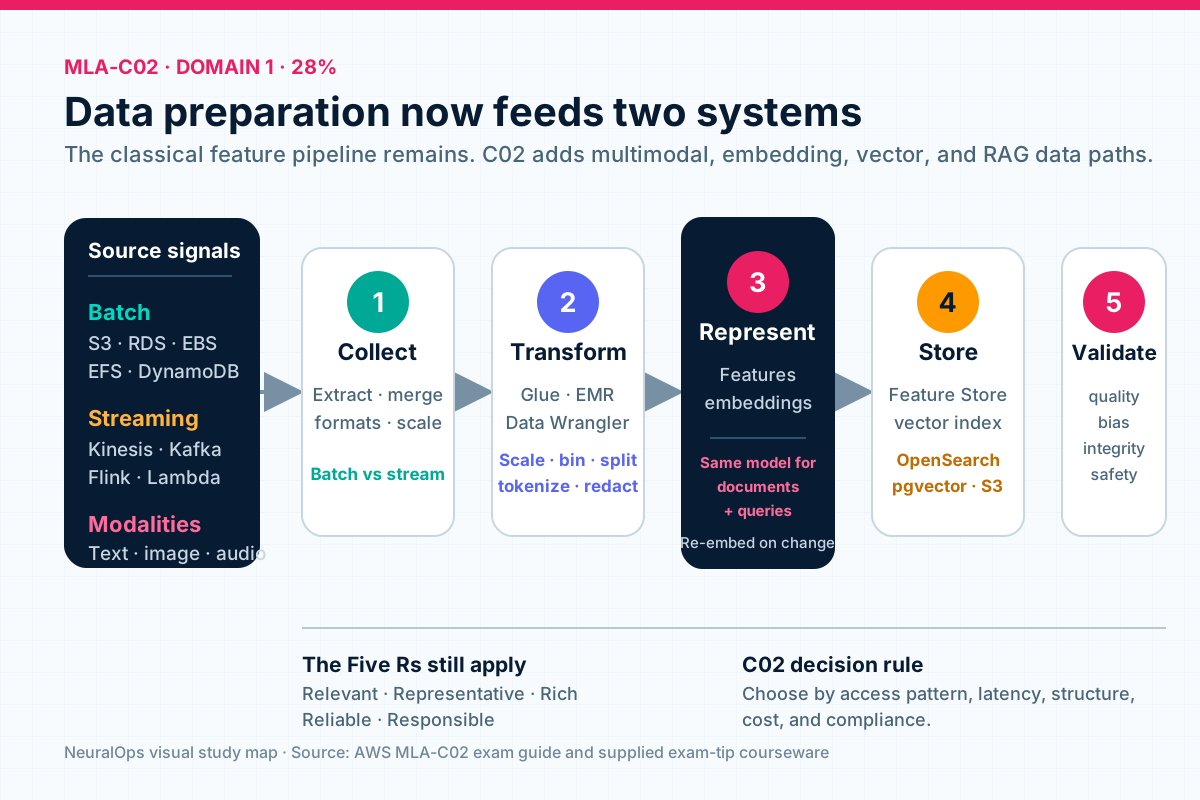
The MLA-C01 core still matters. For ingestion, distinguish batch from streaming and databases from files. DMS migrates databases, DataSync transfers files, Kinesis Data Streams ingests events, Managed Service for Apache Flink performs stateful stream processing, and Data Firehose delivers streams into destinations such as S3, Redshift, and OpenSearch.
For transformation, read the persona and desired control: EMR for maximum customization at scale, Glue for serverless ETL, SageMaker Data Wrangler for ML-focused preparation, and Glue DataBrew for analyst-friendly no-code transformation and quality rules. Feature Store offline storage serves historical training and analytics; the online store serves low-latency inference.
The supplied data-preparation slides remain a strong checklist when corrected for C02. Apply the Five Rs to every dataset: relevant to the prediction or generation task, representative of production, rich enough to carry signal, reliable enough to reproduce, and responsible in collection and use. For numerical features, know when normalization, standardization, log transforms, or binning changes the learning problem. For text, distinguish tokenization from categorical encoding; for high-dimensional correlated features, PCA trades interpretability for a smaller representation.
The quality sequence is still practical: profile and visualize, clean missing values and outliers, make features consumable, split without leakage, then validate the distribution. Use an ordered split for time-ordered prediction, a stratified split to preserve class proportions, shuffling for independent records, and augmentation or SMOTE only after considering whether synthetic examples preserve real-world meaning. Ground Truth provides managed human labeling workflows; Data Wrangler can identify preparation-time imbalance; Clarify measures bias; Model Monitor observes production drift. Those are adjacent jobs, not interchangeable tools.
MLA-C02 adds a second data plane:
Keep the old privacy distinctions: Macie discovers sensitive data in S3, Comprehend detects or redacts PII in text, and Lake Formation controls access at row, column, and cell level. Discovery, transformation, and authorization are different jobs.
Domain 2 - ML Model and FM Development (24%)
Traditional model questions have not disappeared. Know the diagnosis before the remedy: weak training and validation performance indicates underfitting; strong training but weak validation indicates overfitting. Precision penalizes false positives, recall penalizes false negatives, F1 balances both on imbalanced classes, and RMSE measures regression error in the target's units. Hyperband is the tuning strategy that stops poor jobs early to conserve resources.
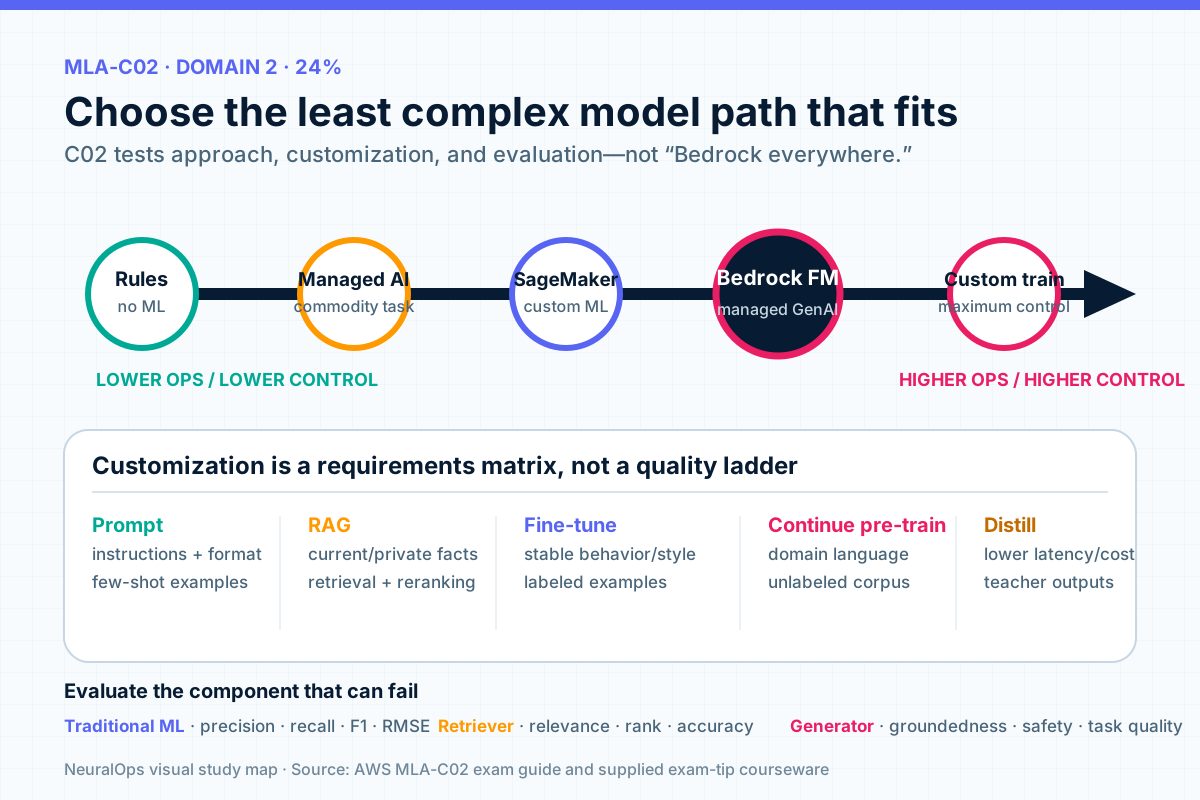
The original slides' “development highway” is still one of the best mental models: do not use ML when deterministic logic is sufficient; use managed AI services for commodity capabilities; use SageMaker AI for custom traditional ML; use Bedrock for managed FM access and GenAI building blocks; accept custom training and hosting only when the control is worth the operational cost. Textract extracts document structure, Rekognition analyzes images and video, Comprehend analyzes text, and Transcribe converts speech to text. Read the modality and outcome before looking at the product names.
For traditional training, separate algorithm choice from training mechanics. Linear models offer interpretability, tree ensembles capture nonlinear interactions, and neural networks buy flexibility at the cost of data, compute, and explainability. Dropout regularizes neural networks; shallower trees and regularization can reduce XGBoost overfitting; early stopping and distributed training reduce wasted time. SageMaker Script Mode brings your own training or inference script into managed framework containers, while Autopilot automates candidate generation and comparison. AMT chooses hyperparameters; Debugger inspects training behavior; MLflow on SageMaker AI records reproducible experiments. C02 removed model-size reduction and SageMaker Neo from the tested scope, so do not spend scarce study time memorizing that old slide.
The new selection ladder is broader:
Do not treat FM customization as a quality ladder. Match the technique to what is missing:
| Technique | Use it for | Primary input |
|---|---|---|
| Prompt engineering | Instructions, format, and task framing | Prompt templates and examples |
| RAG | Current or private facts that change independently of the model | Indexed source documents |
| Fine-tuning | Stable behavior, style, or task specialization | Labeled prompt-response pairs |
| Continued pre-training | Domain language and broad subject adaptation | Unlabeled domain corpus |
| Distillation | Lower latency and cost with a smaller model | Inputs plus teacher-model outputs |
Evaluation must separate system components. For the retriever, measure whether relevant passages are returned and ranked well. For the generator, assess correctness, groundedness, safety, and task quality. MLA-C02 explicitly names human evaluation, BLEU, ROUGE, BERTScore, semantic similarity, bias detection, and LLM-as-a-judge. None is universally best: ROUGE can help with summarization overlap, human review can resolve subjective quality, and LLM judges require calibration because the evaluator is itself a model.
Treat evaluation as a stack. A traditional classification metric cannot tell you whether a retrieved passage was relevant; retrieval accuracy cannot tell you whether the FM ignored good context; and a fluent answer can still be unsafe or ungrounded. Establish component baselines, keep evaluation datasets versioned, compare shadow variants before shifting production traffic, and retain human review for criteria that are subjective or high impact.
Domain 3 - Deployment and Orchestration of ML and AI Workflows (24%)
This is the domain to spend extra hands-on time on. The older courseware has no deployment deck, and MLA-C02 adds more here than anywhere else.
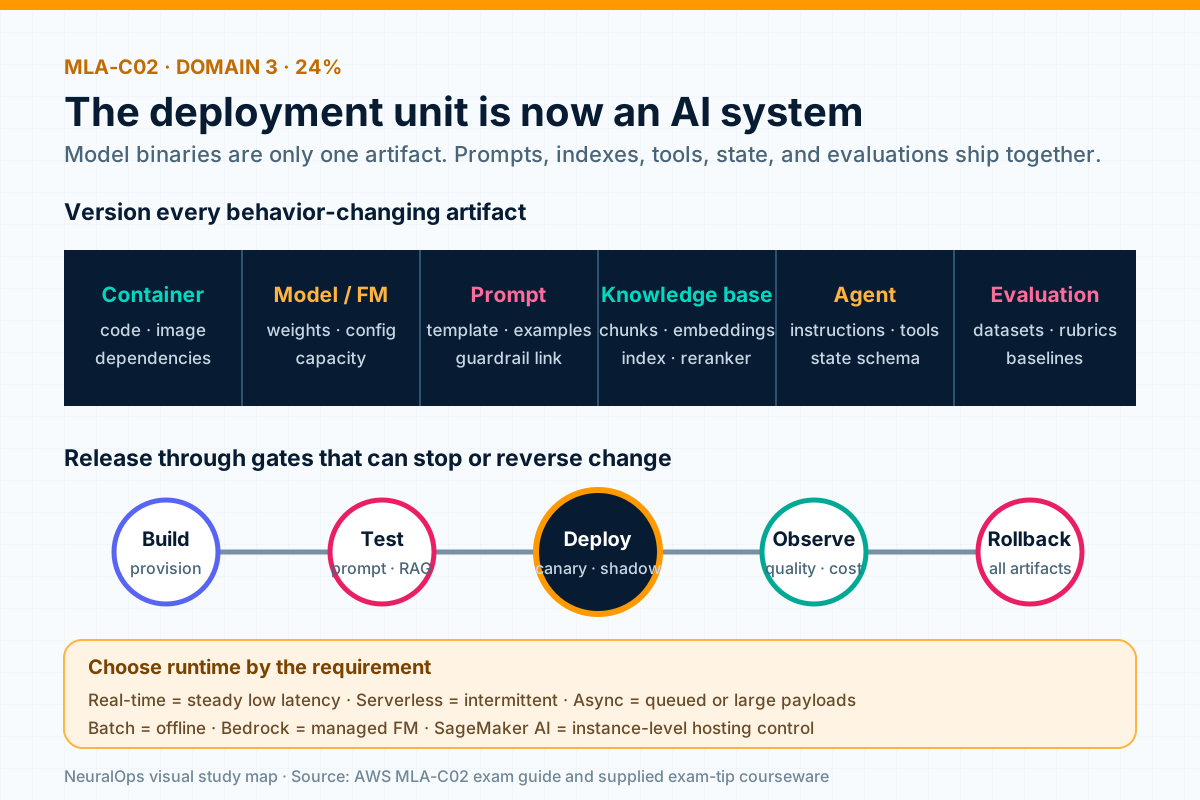
For traditional inference, choose from real-time endpoints for consistently low latency, serverless inference for intermittent traffic that tolerates cold starts, asynchronous inference for queued large payloads or long processing, and Batch Transform for offline datasets. Target tracking follows a metric toward a set point, step scaling reacts more aggressively to thresholds, and scheduled scaling handles predictable demand.
FM deployment adds a different decision surface: managed Bedrock inference, provisioned capacity where predictable throughput justifies it, SageMaker AI hosting when you need instance-level control, and Bedrock Custom Model Import for supported models built outside AWS. Evaluate model compatibility, latency, throughput, customization, isolation, and cost - not just model quality.
A production RAG or agent release has more versioned artifacts than a model release:
source documents → chunking config → embedding model → vector index
       → retrieval + reranking config → prompt version → FM version
       → agent instructions + tools + state schema → evaluation suite
Changing any item can change behavior. Your pipeline therefore needs tests and rollback for prompts, retrieval, agents, and knowledge-base refreshes, not only the model binary. MLA-C02 explicitly calls out Prompt Management, agent deployment and versioning, prompt tests, fine-tuned model versions, and automated RAG update cycles.
For agents, know the operational concerns hidden behind the demo: tool permissions, communication protocols, state persistence, timeouts, idempotency, and failure isolation. Agent state is workload data and must be secured, versioned, and bounded. GPU-backed workloads add quota, capacity, and scaling constraints that ordinary web autoscaling does not solve.
The orchestration choices remain familiar: SageMaker Pipelines for ML-native workflows, Step Functions for multi-service state machines, and MWAA where Airflow is the established scheduler. Model Registry or MLflow can gate model promotion; equivalent controls must gate prompt, agent, and retrieval changes.
Infrastructure questions usually hide one decisive constraint. A real-time endpoint serves steady low-latency traffic; serverless inference fits intermittent demand that tolerates cold starts; asynchronous inference queues large payloads or long jobs; Batch Transform handles offline datasets. Target tracking follows a utilization set point, step scaling reacts to thresholds, and scheduled scaling handles known demand. For FMs, compare managed Bedrock inference, provisioned throughput, SageMaker AI hosting, and Bedrock Custom Model Import by model compatibility, latency, throughput, isolation, and cost.
The CI/CD path should test more than container health. Validate prompt templates against representative inputs, retrieval against expected passages, tool schemas against contract tests, Guardrail behavior against adversarial examples, and end-to-end responses against quality thresholds. Promote immutable versions, refresh knowledge bases deliberately, and keep a rollback target for every artifact that can alter behavior.
Domain 4 - Operating, Monitoring, and Securing ML and AI (24%)
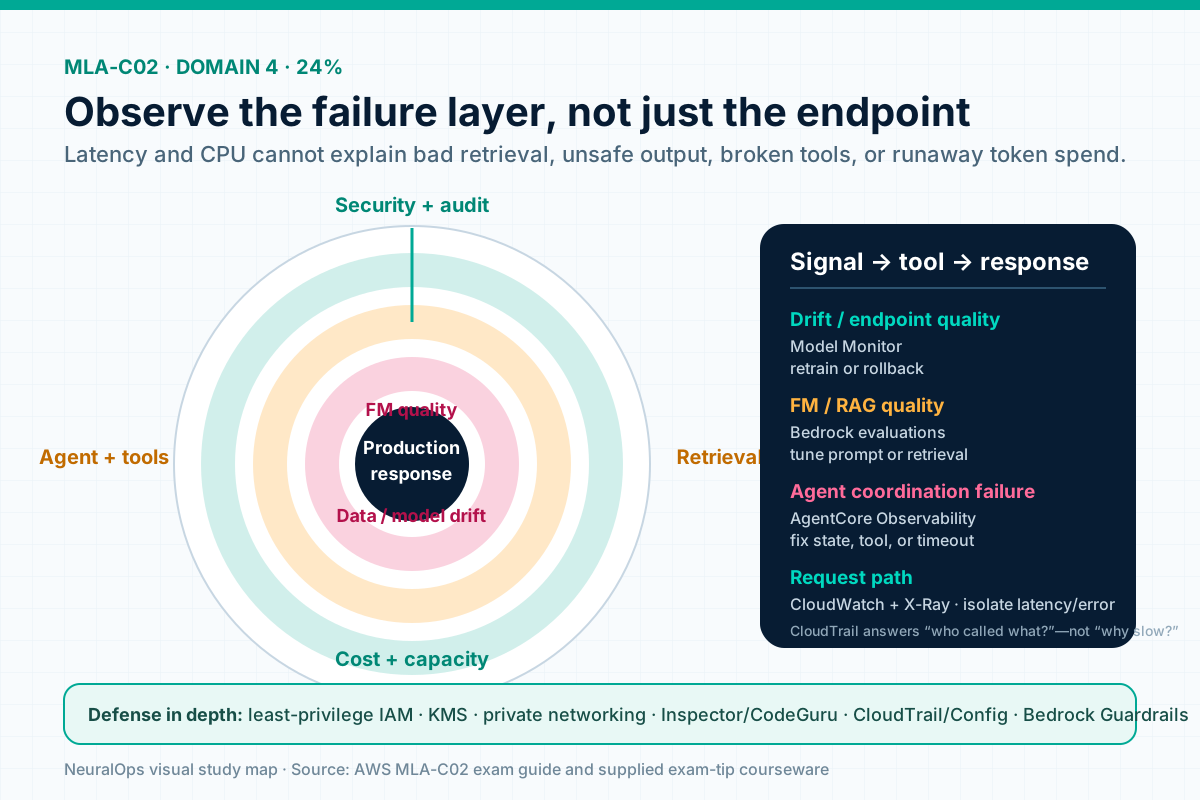
Traditional monitoring starts with a baseline. Model Monitor detects changes in data quality, model quality, bias, and feature attribution; model-quality monitoring needs ground-truth labels. CloudWatch provides metrics, logs, alarms, and dashboards. CloudTrail answers who called which API. X-Ray traces a request across services. These tools complement rather than replace one another.
The monitoring deck's drift map survives C02 with a wider boundary. Data drift means the input distribution moved; concept or model drift means the relationship between inputs and outcomes changed; bias drift means disparities changed; feature-attribution drift means the model relies on different signals. Random Cut Forest remains useful for unsupervised anomaly detection, but an anomaly detector does not diagnose the root cause. Use CloudWatch for operational symptoms, Model Monitor or Clarify for model-specific change, CloudTrail and Config for audit/compliance history, and X-Ray for a request path across services.
GenAI adds signals that CPU, latency, and error rate cannot explain:
| Signal | Observe with | Likely response |
|---|---|---|
| FM output quality or safety | Bedrock evaluations, human review, quality metrics | Change prompt, model, Guardrail, or customization |
| Retrieval accuracy | RAG evaluation and retrieval traces | Change chunks, metadata, embeddings, filters, or reranking |
| Tool, coordination, or truncated-stream failure | Amazon Bedrock AgentCore Observability, CloudWatch, X-Ray | Fix tool contract, state, timeout, retry, or routing |
| Cost growth | Token, embedding, vector storage, and resource metrics | Cache, route, batch, shorten context, or right-size capacity |
For cost questions, optimize the unit that actually grows. FM inference cost follows input and output tokens, model choice, and capacity mode. RAG also pays for embedding computation and vector storage. Agents multiply calls across planning and tools. A cheaper model can lose overall if poor retrieval or retries cause more invocations.
Security remains defense in depth. Use least-privilege IAM, private networking where required, KMS for encryption at rest, TLS in transit, and CloudTrail plus Config for audit and compliance. MLA-C02 adds three high-value distinctions:
Responsible AI is an operating requirement, not a one-time model-development checklist. Monitor bias and safety after deployment, keep evaluation datasets versioned, log configuration changes, and preserve an auditable path from source documents and prompt versions to production responses.
The source deck's defense-in-depth stack remains correct: data protection, application controls, network and edge protection, infrastructure protection, threat detection and incident response, and policies/procedures should reinforce each other. Least-privilege IAM does not replace KMS; encryption does not replace private networking; Guardrails do not replace authorization. C02 also expects vulnerability checks in CI/CD with services such as Inspector and CodeGuru, plus credential decisions for Bedrock clients. Prefer short-lived role credentials for AWS workloads and never embed API keys in source.
What changed from the supplied exam-tip decks
The visual maps above synthesize all three unique -exam-tips-slides.pdf sources: Data Preparation Exam Tips (56 pages), Model Development Exam Tips (57 pages), and ML Solution Monitoring, Maintenance, and Security Exam Tips (9 pages). Thirty-nine pages are incremental answer reveals rather than new learning content.
| Source area | Use for C02 | Correction |
|---|---|---|
| Weights and lifecycle | Rewrite | Use 28/24/24/24 and add FM, RAG, and agent paths |
| Data and feature fundamentals | Keep and modernize | Add vectors, multimodal data, FM datasets, integrity, and safety |
| Model development | Keep and modernize | Replace the customization ladder; remove model-size reduction/Neo focus |
| Bias review question | Correct | TVD is half the L1 distance, not “maximum disparity” |
| XGBoost review question | Rewrite | Depth and regularization can both address overfitting; the old single answer is ambiguous |
| Question format | Rewrite | C02 uses multiple-choice and multiple-response, not matching interactions |
| Deployment/orchestration | Build new | The supplied courseware has no equivalent deployment exam-tip deck |
The older transfer and training-I/O slides are still useful background, but DMS/Snowball selection and Fast File Mode should not dominate a C02 plan. AWS explicitly removed EFS/FSx training-resource loading, model-size reduction, SageMaker Neo edge optimization, BYOC, and several older capacity-monitoring examples from the tested outline. Storage, containers, scaling, and monitoring still matter where the new task statements include them; the deletion is about the old framing, not a claim that the services stopped existing.
The MLA-C02 distractor list
Memorize decision boundaries, not product descriptions:
How I would prepare
Build two connected paths, not two unrelated demos.
Path one: traditional ML. S3 → Glue or Data Wrangler → Feature Store → SageMaker training and tuning → Model Registry → real-time endpoint with autoscaling → Model Monitor and a retraining trigger.
Path two: GenAI. S3 corpus → chunking and metadata → embeddings → Bedrock Knowledge Base and vector store → retrieval and reranking → prompt and FM → agent tools and state → evaluation, Guardrails, observability, and an automated index refresh.
Then break them deliberately. Introduce schema drift, stale documents, a missing KMS permission, a tool timeout, a bad chunking change, and a token-cost spike. The exam asks what to do when systems fail; a happy-path console tour does not teach that.
Read the official guide twice. Its in-scope and out-of-scope service lists are explicitly non-exhaustive, so treat them as a strong prior rather than an allowlist. Spend study time by the 28/24/24/24 weights, with extra lab time on Domain 3 because its MLA-C02 additions are broad and the supplied MLA-C01 courseware does not cover deployment.
Key takeaways
Further reading
Preparing for MLA-C02, or building the platform that runs these workloads? Let's talk about production ML and GenAI architecture.